
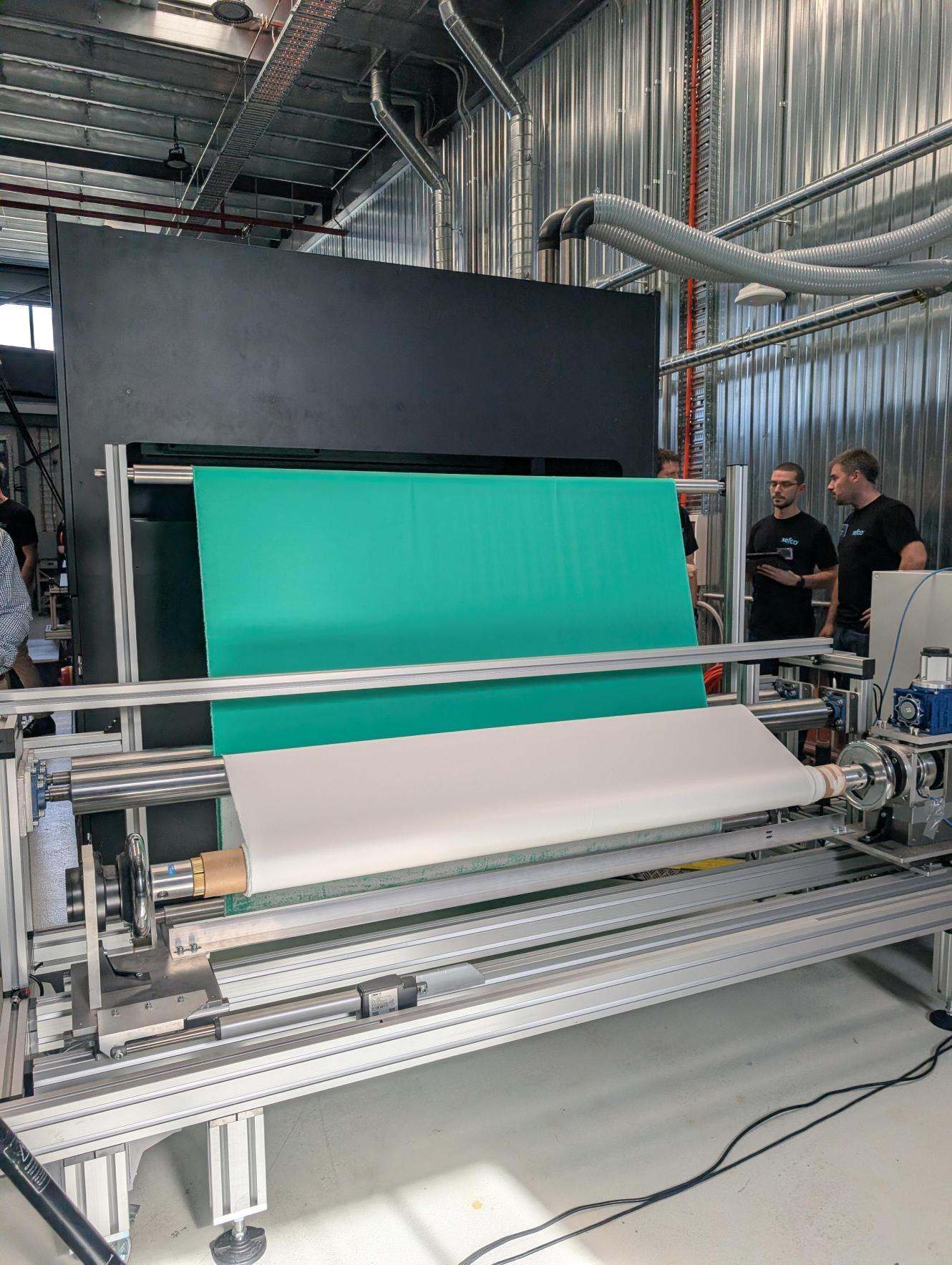
Breakthrough Victoria portfolio company Xefco has reached a major commercial milestone, preparing to ship its first commercial‑scale Ausora® system to Indonesia - the world’s first deployment of a waterless plasma textile dyeing machine operating at full industrial scale.
The shipment marks a decisive transition for the Geelong‑based company: moving from Australian research and development into live deployment of proprietary hardware within global manufacturing supply chains. The move sees Xefco leading the charge in exporting Victorian advanced manufacturing capability to one of the world’s largest textile markets.
The milestone is backed by a $4,999,122 grant from the Australian Government’s Industry Growth Program (IGP), supporting Xefco to manufacture its Ausora® systems locally and commercialise technology that eliminates water dependency and wastewater treatment from textile dyeing - while using around 90 per cent less energy and cutting greenhouse gas emissions by up to 94 per cent compared to conventional wet dyeing processes.
“This is exactly the kind of global impact we back,” said Rod Bristow, CEO of Breakthrough Victoria.
“Xefco has transformed world‑class Victorian research and engineering into a commercially viable manufacturing system that’s now being deployed globally. It shows how Australian deep tech, when backed with the right support, can compete, and lead, internationally.”
Addressing the most resource intensive stage of textile manufacturing
Textile dyeing and finishing remains the most environmentally intensive stage of the global textile supply chain, carrying some of the highest costs, compliance burdens and operational risks for manufacturers.
Ausora® removes process water entirely, eliminates wastewater output, and significantly reduces energy use and chemical inputs: delivering manufacturers a pathway to modernise operations while meeting tightening environmental regulations and brand‑driven sustainability requirements.
“The existing water‑intensive processes used to put colour and functional finishes on fabrics carry the highest cost and compliance burden in the textiles supply chain,” said Tom Hussey, CEO and Co‑Founder of Xefco.
“Investment and recognition from government reflects what we’re already seeing in the market - strong commercial demand, with twelve units already committed and active installations underway in key manufacturing regions, including Indonesia and Vietnam.”
A deliberate first market
Indonesia is one of the world’s largest garment manufacturing hubs, employing more than 3.7 million people and supplying leading fashion brands across the United States, Europe and beyond.
The industry is under increasing pressure to modernise in response to rising costs, tightening environmental regulation and growing demand from global brands for supply‑chain transparency, resilience and responsiveness.
Xefco’s Indonesian launch partner is a major garment manufacturer supplying some of the world’s leading fashion brands - an early signal of the calibre of industry player adopting the technology.
From Australian R&D to global deployment
The Indonesian deployment represents a turning point for Xefco, transitioning from an Australian R&D‑led company to one delivering proprietary, export‑ready industrial systems into international manufacturing environments.
Ausora® is designed in modular form, with each segment capable of processing up to 2.2 million metres of fabric per year. Multiple segments combine to scale capacity. Under Xefco’s embedded manufacturing services model, the system operates at cost parity with conventional dyeing, removing upfront capital barriers for factories while delivering major operational and environmental gains.
Xefco provides on‑the‑ground technical support through a locally registered, Australian‑owned Indonesian entity staffed by specialist engineers, and has also established a presence in Vietnam to support future deployments. Additional installations are underway or planned in China and the United States.
Inside the Ausora® system
Roughly the footprint of a shipping container, the Ausora® unit runs fabric through a continuous roll‑to‑roll process using Xefco’s proprietary Plasma Enhanced Chemical Vapour Deposition (PECVD) technology operating at atmospheric pressure.
Visible as a soft purple glow, the plasma process embeds and fixes pigments directly into fibres while depositing an ultra‑thin functional coating - all in a single pass. Unlike other waterless technologies, Ausora® works across synthetic and natural fibres, including cotton, polyester, nylon and blended materials.
“Twelve units are already commercially committed, and we have a strong pipeline beyond that,” said Hussey. “The industry has made its position clear. Our focus now is scaling manufacturing capacity to keep pace with demand.”
Australian manufacturing, global reach
Ausora® was developed through applied research at Deakin University, and each system is manufactured in Geelong, Victoria.
Xefco’s 47‑person team operates across Australia, Taiwan, Vietnam and Canada. With a target of 200 systems deployed globally within five years, the company projects the creation of approximately 300 advanced manufacturing jobs in Geelong and around $200 million in domestic manufacturing expenditure.
Backed by Breakthrough Victoria, other private investment, government grant support and early commercial traction, Xefco is scaling rapidly to meet growing global demand, with the Indonesian deployment providing a live operational proof point as the company explores further funding opportunities later in 2026.
Xefco at a glance
- First commercial‑scale deployment of a waterless plasma textile dyeing system globally
- 97% reduction in chemical use, 90% lower energy consumption, 94% fewer greenhouse gas emissions
- 100% elimination of wastewater output
- 2.2 million metres of fabric per Ausora® segment per year, with modular scalability
- 12 systems already commercially committed
- 200 systems targeted globally within five years
- ~300 advanced manufacturing jobs projected in Geelong
- $200 million projected domestic manufacturing expenditure