
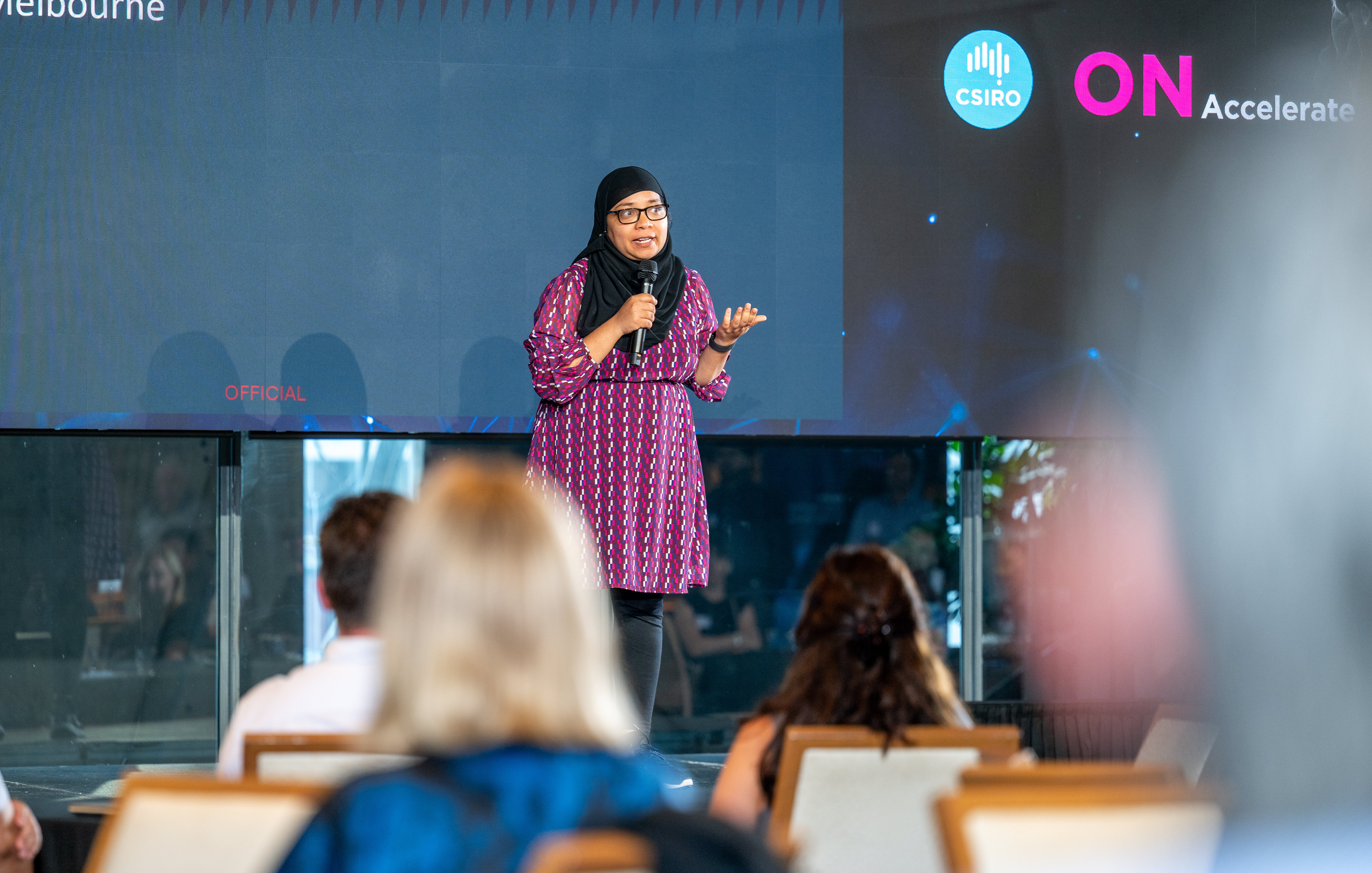
Breakthrough Victoria Fellow, Noor E Karishma Shaik (University of Melbourne Research Fellow), founder of DeepDerm, is developing a new AI tool, DermAI, that can detect skin cancer non-invasively through high-resolution images for frontline healthcare, especially rural communities. This tool aims to pathology-grade classification with just a click, eliminating the need for biopsies.
1. Looking back to when you applied, what convinced you the BV Fellowship was the right step for your idea or research?
For me, it came down to alignment. I tend to look at problems from a whole system perspective - from the university view, the industry view, and the investor view. Around the time I applied, we were exploring options for raising investment. There were plenty of pathways, but what stood out about Breakthrough Victoria was their ability to speak both “languages”: they understand investors and business, but they also understand universities and industry partners.
That dual perspective made the transition feel natural, rather than disruptive. I didn’t feel like I had to become a different person overnight. I could continue the work I cared about, but now with support to build meaningful commercial progress. Whenever there was resistance, I felt empowered to challenge it - not defensively, but because the Fellowship model resonated with the work I wanted to do.
Honestly, without the BV Fellowship, we wouldn’t have been able to launch a startup at all. The technology was ready, but turning it into a venture needed a bridge. BV became that bridge.
2. How has your project or startup evolved over the past 6–12 months, and what role did the Fellowship play?
I’ll answer this in two parts - how the company evolved, and how BV supported that journey.
How the startup evolved:
My PhD resulted in a patented high-performance skin cancer imaging camera. With an AEA grant, we validated it specifically for skin cancer diagnosis. By the time I received the Fellowship, we incorporated the company. Initially, we were purely a “skin cancer camera.”
Today, we’ve evolved into a holistic dermatology care solution. We still support clinicians with accurate imaging, but now there’s also a companion patient app enabling continuous communication with clinicians whenever a skin change occurs.
The system flags high-risk changes so clinicians can focus their time where it’s needed most, while patients receive more engagement and timely responses. It’s still the same price point, but with dramatically more value.
How the Fellowship contributed:
We’ve always believed in deep customer conversations. Before landing on skin cancer, we did over 100 interviews. After that, another 50 discussions with clinicians led us to refine the product into something more focused and relevant.
Where BV really helped was preventing us from getting lost in “doing everything.” The Fellowship gave us structure - what to prioritise in the first year, when to move, and when not to move. Conversations with the BV team, including weekly chats with mentors, helped us focus our commercialisation work rather than spread ourselves thin.
I call it “focused commercialisation”: doing fewer things, but the right things, at the right time.
3. What has been the biggest shift for you personally in moving from researcher or innovator to founder?
As a researcher, you’re trained to be methodical - slow, thorough, risk averse. Ten years in academia had made me cautious. Everything needed to be certain, validated, peer reviewed.
Becoming a founder forced me to rediscover my ability to take risks. Life is like an ECG graph: if it’s flat, you’re not living. Startups bring highs and lows, but that movement means growth.
I had to relearn how to try things even with uncertainty. That mindset shift - being okay with failing at times - enabled us to transform from a niche imaging tool into a comprehensive dermatology care system. In research, even a 1% chance of failure might stop you from trying. In startups, you often try because there’s a chance it might work.
The Fellowship created the buffer we needed to experiment safely. It made room for curiosity and risk-taking again.
4. Can you describe a breakthrough moment over the past 6 months where you realised your work had real commercial potential?
This happened just last month during our clinical trials - over the Christmas break, of all times. Because clinics stay open, I kept working closely with nurses and clinical staff. They’re not the primary decision makers, but they are the decision enablers. If nurses embrace a technology, adoption becomes easier across the organisation.
During the trial, I encouraged them to test the tool themselves. What happened next surprised me. Within a few weeks, nurses who had never used a thermal or medical grade camera were diagnosing and capturing images confidently. One of them even spotted a squamous cell carcinoma - accurately.
That was a powerful moment. Their excitement made it clear that the tool wasn’t just usable - it was useful. We even restructured the trial so nurses, not researchers, were leading the process. By the end, I wasn’t needed onsite at all.
That experience saved us a year of planned work and confirmed real clinical readiness - and commercial viability.
5. If you had to distil one lesson from your first year of building a company, what would it be?
Perfectionism is the enemy of progress.
In the early months, I approached the startup like a PhD thesis - everything had to be precise, structured, flawless, I treated every task like a lifelong mission.
If I could speak to my self six months ago, I’d say: chill.
Focus on the vision, not perfection.
A startup evolves like a relationship or raising a child - you move through stages. Early stage investors lead to Series A and Series B investors. What’s relevant today may not be relevant six months from now.
The only constant is your vision. That’s the part you must obsess over.
Everything else? Let it evolve. Keep moving. Know where your energy matters most.